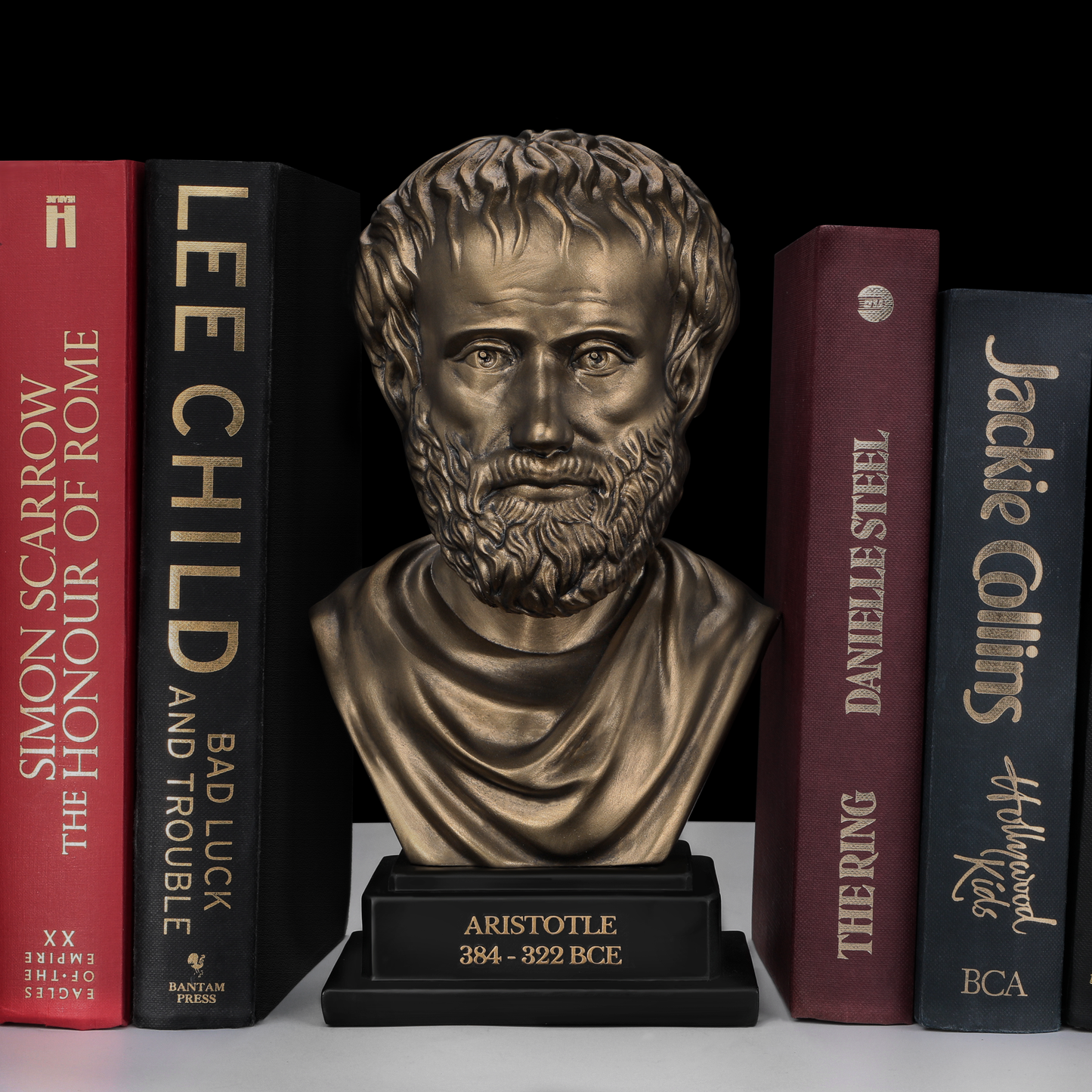
Aristotle Bust: The True Story Behind the Most Famous Ancient Greek Philosopher Portrait

Aristotle Bust: The True Story Behind the Most Famous Ancient Greek Philosopher Portrait
The bust of Aristotle – with its broad forehead, short beard, and contemplative gaze – is instantly recognisable as the face of Western philosophy’s greatest mind. For over 2,300 years it has symbolised logic, ethics, and the pursuit of knowledge.
The Lost Original by Lysippus (c. 330 BCE)
The ancient Greek sculptor Lysippus, court artist to Alexander the Great, created the original portrait of Aristotle around 330 BCE. Aristotle was then in his 50s, teaching Alexander and founding the Lyceum. No original survives, but Roman copies from the 1st–2nd century CE preserve the likeness.
Key Features of the Authentic Aristotle Portrait
- Broad, high forehead – symbol of intellect
- Short, neatly trimmed beard – the mature philosopher
- Deep-set eyes with upward gaze – contemplating the eternal
- Simple, unadorned hair – no idealisation
- Slight turn of the head – adds life and thoughtfulness
The Most Important Surviving Copies
- Kunsthistorisches Museum, Vienna – marble portrait bust (our primary reference)
- Louvre Museum, Paris – marble portrait bust
- Capitoline Museums, Rome – marble portrait head (under Italian cultural protection laws)
- National Archaeological Museum, Naples – double herm with Plato
Italian Cultural Heritage Laws and Reproduction Restrictions
Italy’s cultural heritage laws (Codice dei Beni Culturali e del Paesaggio, Legislative Decree No. 42/2004) are among the strictest in the world, classifying ancient Roman copies like the Capitoline Aristotle as national patrimony. Direct casting or reproduction requires Ministry approval, with violations leading to heavy fines and litigation – Italy has successfully pursued international repatriation cases against major museums.
To avoid any risk, our Aristotle bust is based on the outstanding marble portrait in the Kunsthistorisches Museum in Vienna, Austria.

Why This Portrait Became the Standard
Many modern illustrations show Aristotle as an old man with a long flowing beard (often confused with Plato or Socrates). The surviving ancient portraits show a cleaner, more refined look – the version we chose for the Acclaimed Figures bust.
Aristotle Bust Replicas
Original ancient marble copies are priceless museum pieces. The most accurate modern replicas are now produced in hand-casted unsaturated resin – offering excellent detail retention and durability.
At Acclaimed Figures we use hand-casted unsaturated resin for every bust, ensuring lifelike features and long-lasting quality. Our Aristotle bust is inspired by the Kunsthistorisches Museum Vienna portrait, available in Antique Bronze or Stone White, 25.5 cm tall, on an engraved charcoal base with “Aristotle 384–322 BCE”.
→ View the Aristotle Bust Replica