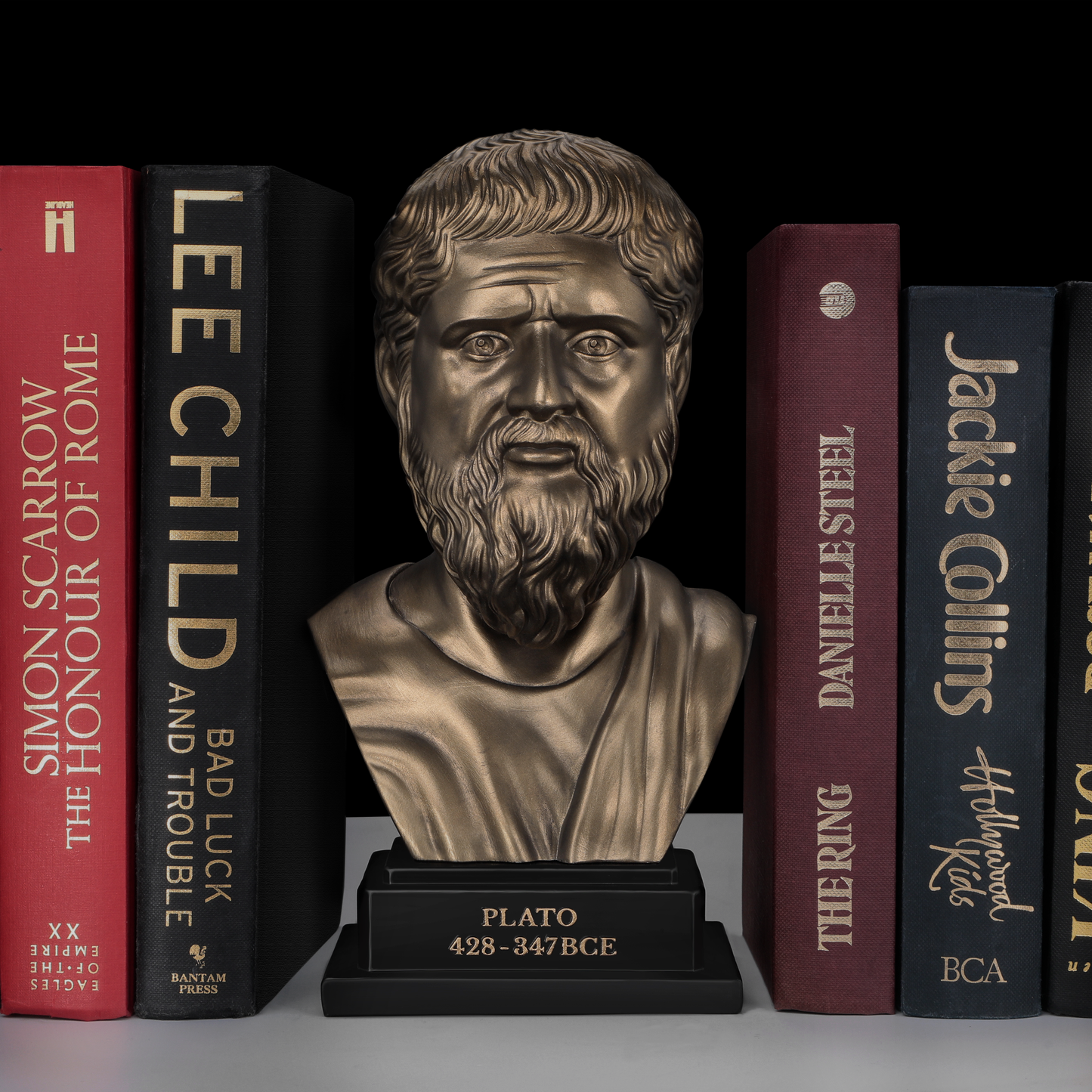
Plato Bust: The True Story Behind the Most Famous Ancient Greek Portrait

Plato Bust: The True Story Behind the Most Famous Ancient Greek Portrait
The bust of Plato – with its broad forehead, short beard, and calm, upward gaze – is instantly recognisable as the face of Western philosophy. For over 2,300 years it has been the visual symbol of wisdom, reason, and the Academy.
The Lost Original by Silanion (c. 350 BCE)
The ancient Greek sculptor Silanion created the original portrait of Plato around 350 BCE, when the philosopher was in his late 70s. The statue stood in the Academy in Athens and was considered one of the most lifelike portraits of the era. No original survives, but Roman copies from the 1st–2nd century CE preserve the exact likeness.[1]
Key Features of the Authentic Plato Portrait
- Broad, high forehead – symbol of intellect
- Short, neatly trimmed beard (unlike the long beards of Socrates or later philosophers)
- Upward gaze – the classic “contemplating the Forms” look
- Simple, unadorned hair – no wreath or idealisation
- Slight turn of the head – adds life and movement
The Most Important Surviving Copies
- Glyptothek, Munich – marble portrait bust (our primary reference; Roman copy of Silanion’s original)
- Capitoline Museums, Rome – marble portrait head (under Italian cultural protection laws, limiting reproductions)
- Ny Carlsberg Glyptotek, Copenhagen – one of the finest Roman copies
- Vatican Museums – herm with inscribed “ΠΛΑΤΩΝ”
- Metropolitan Museum of Art, New York – marble portrait (secondary reference)
Why This Portrait (Not Other Versions) Became the Standard
Many modern illustrations show Plato as an old man with a long flowing beard (often confused with Socrates). The authentic Roman copies show a cleaner, more refined look – exactly what we chose for the Acclaimed Figures bust.
Plato Bust Replicas
Original Roman marble copies are priceless museum pieces. The most accurate modern replicas are now produced in premium polyurethane resin – cast directly from the best surviving Roman examples.
At Acclaimed Figures we use the Glyptothek Munich portrait as the master reference (the Capitoline version in Italy is under strict cultural protection laws). This reproduces every detail of the original Silanion design. Available in Antique Bronze (the most popular finish) or Pure White, 24.5 cm tall, on an engraved charcoal base with “Plato 428–348 BCE”.