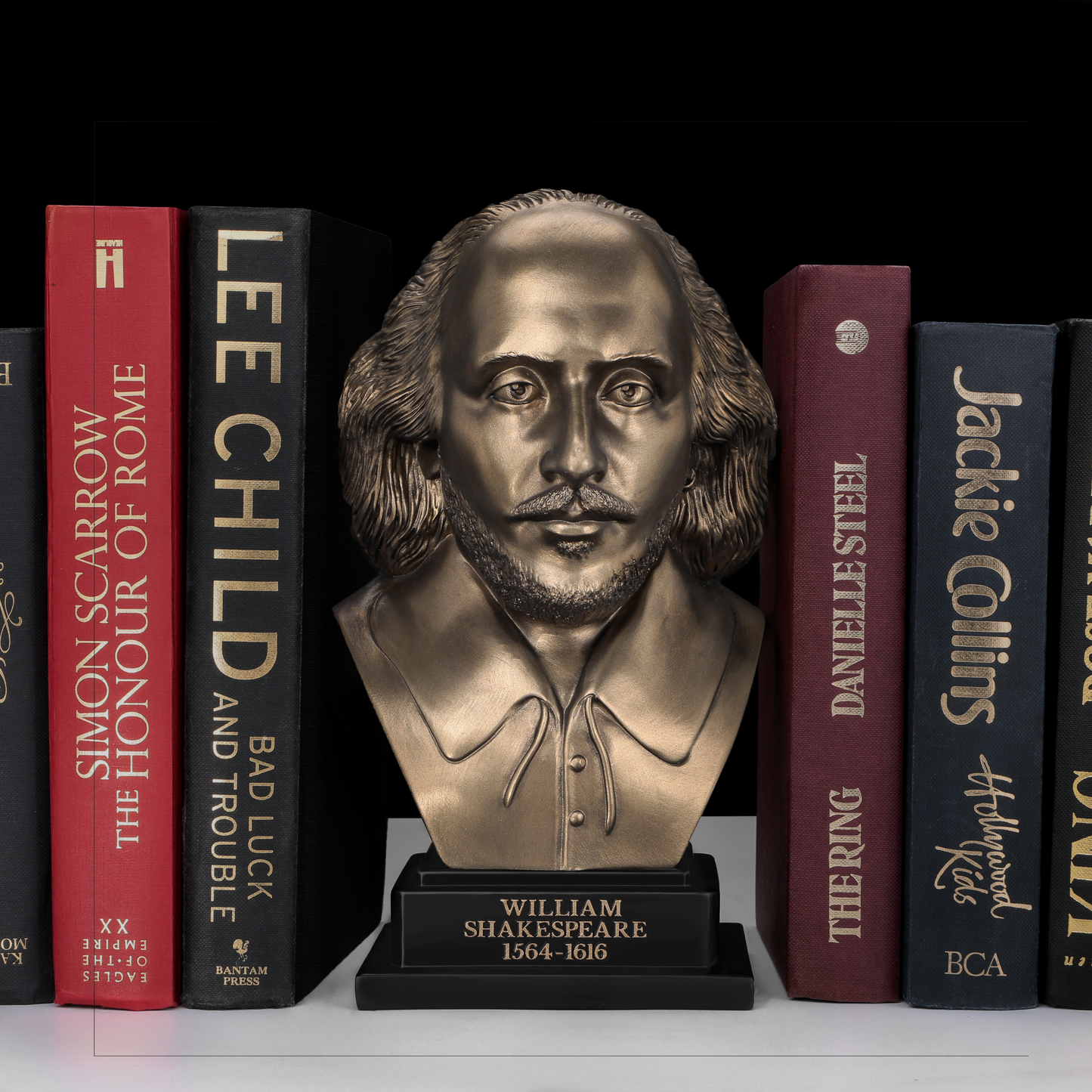
William Shakespeare Bust: The True Story Behind the Most Famous Bard Portrait

William Shakespeare Bust: The True Story Behind the Two Most Famous Bard Portraits (and Which One We Chose)
Two images dominate when people picture William Shakespeare:
- The formal, high-collared engraving by Martin Droeshout on the First Folio title page (1623)
- The intimate, earring-wearing painting known as the Chandos portrait, attributed to John Taylor (c. 1610)
Both are masterpieces. Here’s the real story – and why we chose one over the other for our bust.
The Droeshout Engraving (1623) – The Official First Folio Portrait
Published seven years after Shakespeare’s death, the Droeshout engraving on the title page of the First Folio (1623) was approved by his friends and fellow actors. It shows Shakespeare in a high-collared doublet with a direct, confident gaze. This became the “official” image reproduced on monuments and book covers for centuries.

The Chandos Portrait by John Taylor (c. 1610) – The Only Lifetime Likeness
The Chandos portrait, attributed to John Taylor and painted around 1610, is the only portrait believed to have been done during Shakespeare’s lifetime (or very shortly after). It shows him with a balding head, gold hoop earring in the left ear, moustache, and a relaxed, knowing expression. Owned by the National Portrait Gallery in London, it is widely accepted as the most authentic likeness.

Which Portrait Is More Authentic?
The Droeshout engraving is posthumous and stylised. The Chandos portrait – painted while Shakespeare was alive – captures the real man: successful, stylish, and enigmatic. It is the image most scholars consider the truest to life.
Why We Chose the Chandos Portrait by John Taylor for Our Bust
After studying both originals, we chose the Chandos portrait attributed to John Taylor as our master reference because it is the only known lifetime likeness – showing Shakespeare at his most authentic, confident, and human. This is the version that defined the Bard for generations.
Our 25.2 cm Shakespeare bust is cast from this National Portrait Gallery masterpiece, available in Antique Bronze or Stone White, on an engraved charcoal base with “William Shakespeare 1564–1616”.
→ View the William Shakespeare Bust Replica